
Recently I had the opportunity to speak with a class of designers on the topic of presenting their work. One of the most important skills a designer can have is the ability to sell their work, but they often aren’t taught how to do that in school. It’s a frustrating part of hiring: incredible designers often can’t tell me how they got to their solution. If they can’t tell me, how can they tell a client who may not even understand the design process?
When I went to school, I focused on the craft and details of a project. What I should have focused on was storytelling. Looking back at the years of my career, I have a shorthand list of specific interactions that stand out in my memory, but the number of times I have had to get someone excited about my work is astronomical.
Stuffing the deck
Looking back, I remember one of my early presentations - a young designer, working at an education start-up, the world in my hand. I was so proud of all the work I had done, and I wanted to show the clients everything we had made. Surely they’d be thrilled to see how much STUFF we’d put together for them!
I made a beautiful PowerPoint deck, a slide for each screen of our website with a nice write-up of what they were looking at. I read every word, showed them every button and form, proud of the tiniest detail.
This meeting went over like a ton of bricks. The work was fine, but the meeting was a dead-end. What I hadn’t realized is that a part of my job was also to get people excited. It must have felt like looking at a stranger’s vacation photos. It’s also my job to guide, to ask questions, to turn from an entertainer to a facilitator.
I needed a story, and I needed a plan.
Over the next few years, I got better at presenting. I stopped looking at it as an opportunity to show something, and started looking at it as a means to accomplish a goal. I started making things more interesting for the audience, and realizing that something I may be proud of - like an exciting interaction making a more whimsical experience - may not be what people are watching for or wanting. I also started to create a process around telling these stories.
What I learned from watching the best presenters is that there are a thousand things that will make any presentation better. Three things will make any presentation great.
1. Why are you here?
If you don’t know who you’re talking to and what you’re trying to accomplish, you’re wasting everyone’s time. Figure out what your goal is so that you can tailor your story to that.
When I showed that deck stuffed full of all the parts, my reason was that I was excited and proud of the work. What I needed to remember is that the client needed to understand how we were solving their problem.
2. Show, don’t tell
We’re visual creatures; pictures stick out in our minds far more easily than words do. Remember that your audience isn’t there to watch you read, and they aren’t there to read themselves. They want to hear your thoughts, in your own words.
A slide on screen should always be thought of as punctuation, adding emphasis to your words, or providing visual proof.
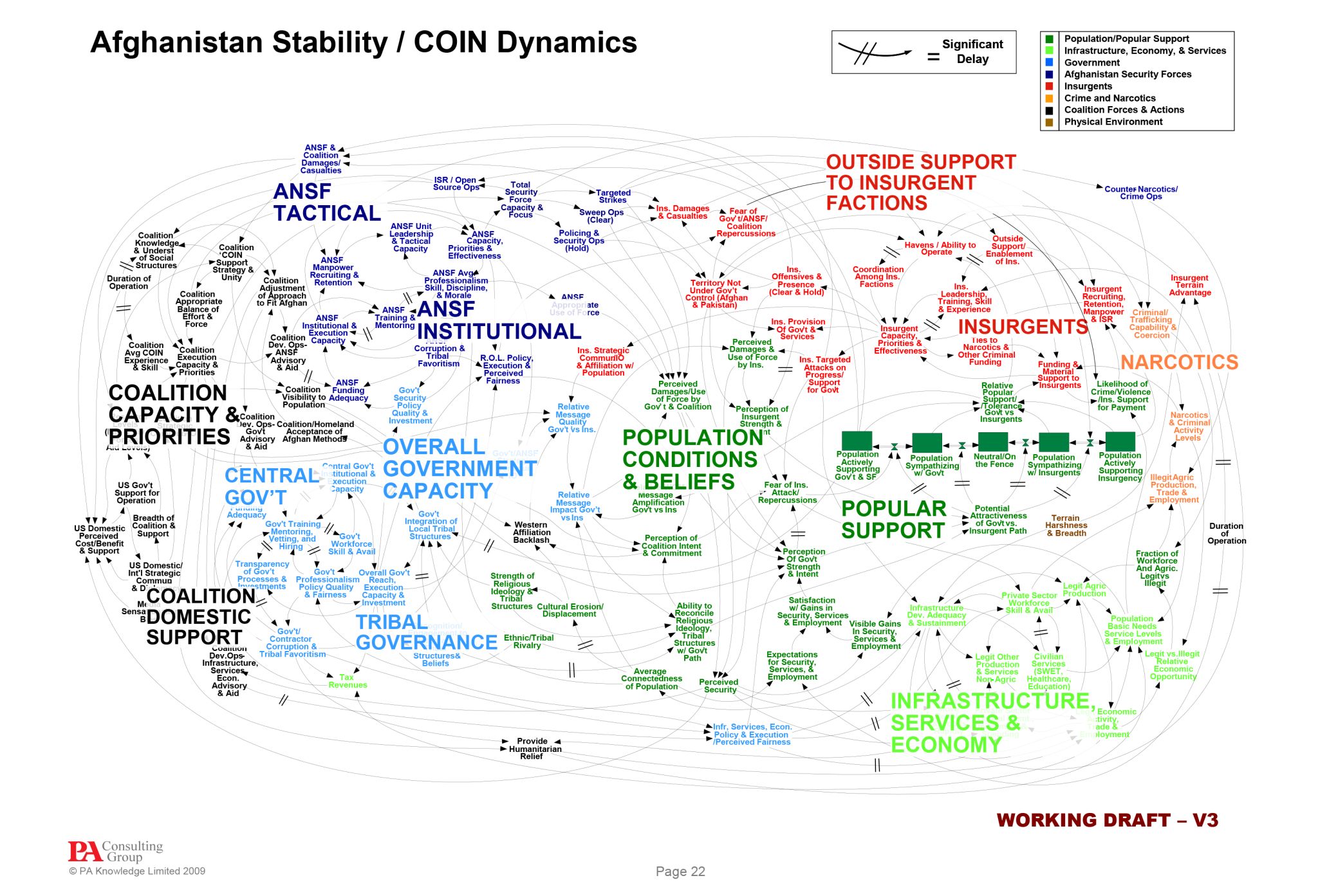
This slide was actually used by the US Department of Defense, and was made famous years ago for just how illegible it is. Our presentations don’t often carry the weight of a military strategy, but sometimes it can feel like this image looking at a design presentation.
Apple understands this. When they introduce a new product, they actually use it on stage, instead of just showing a picture. The sight of their presenters making a call, or calling up a website, or sending an email was incredible, and they went to extremes to make that happen.
When the original iPhone was announced, it barely worked. AT&T had to make a private cell network in the conference hall just so Steve Jobs could make that famous call to Jony Ives. There was a team of people who had stitched together all the pieces of the software, up until the moments before the presentation. The phone hadn’t actually worked in any of the presentation trial runs! It was worth the extra effort because the best way to show a product is to show it in action. When Jobs took to the stage and showed that this amazing device existed and worked, it changed the way people looked at their phones forever.
3. Make them care
Your biggest challenge is keeping someone interested.
You’re going to need to make your audience care as much as you do. You need your passion, your effort, and your knowledge to shine through. If you don’t care, nobody will.
Make sure you know your work better than anyone else in the world. Care about it, in the way you know your clients care about their business. Give them what they need to be successful in their own role. When I worked at AKQA we had a saying, “we’re already known, our job is to make our clients famous.” The point was that we weren’t in it for us, we were in it for them.
Telling the story
When you start this presentation, you need to kick off with what you want. You want sign-off. You want the job. You want them to go all in and stand with you, against the world.
That is your call to action, but you need to get them excited enough to pay attention. That’s your call to ADVENTURE.
That call to adventure starts at the beginning of your story. Tell them why you’re there, and make a promise they can get excited about. Give them a problem and make clear why it affects them. Show them how you can solve it. Then tell them how they can help, because this is where you ask for whatever it is you want.
Villains and heroes
Every story needs a villain. Without a villain, there can be no hero.
One of the people who really understood this was Steve Jobs.
Back to the announcement of the original iPhone, Jobs introduced the iPhone by starting with a bad guy, the existing smartphones. The problem with keyboards, the problem with styluses, the problem with small screens and browsers, and cheap quality - he reminded us of those frustrations, setting up the villain before he told us who would be the savior.
If we didn’t know we had a problem before, by the time he pulled the iPhone out of his pocket, we did.
Wrap up
With all this in mind, it’s important to stop and remember that your presentation is more than a slide on screen. When the power fails, or your computer crashes, you are still in control of how well your meeting goes. You are in control of how passionate you are; you are in control of your product quality. But if you get the product right, these will make the difference between an OK presentation and one that engages and excites.
Be the most knowledgeable person about your product. Be the most excited person about your product.
And tell the story of why people should care.