
Since ChatGPT was released to the public in 2022, it has captured the imagination of product designers throughout tech, resulting in a wave of innovative…. chats.
That makes sense; Open AI created the model for a dynamic chatbot that answers your questions pretty accurately in a way that sounds almost lifelike. People used ChatGPT and were inspired to add a natural language interface to their own products, sometimes with significant impact. Just think, complex interfaces that require training and subject matter expertise can become a quick question typed out to the bot, and you’ll get an equally quick answer back!
That’s really burying the lede, though, and missing the opportunity we have as designers to solve human problems. Instead, we should think about making AI invisible and getting it to do much more work for people.
Asking good questions
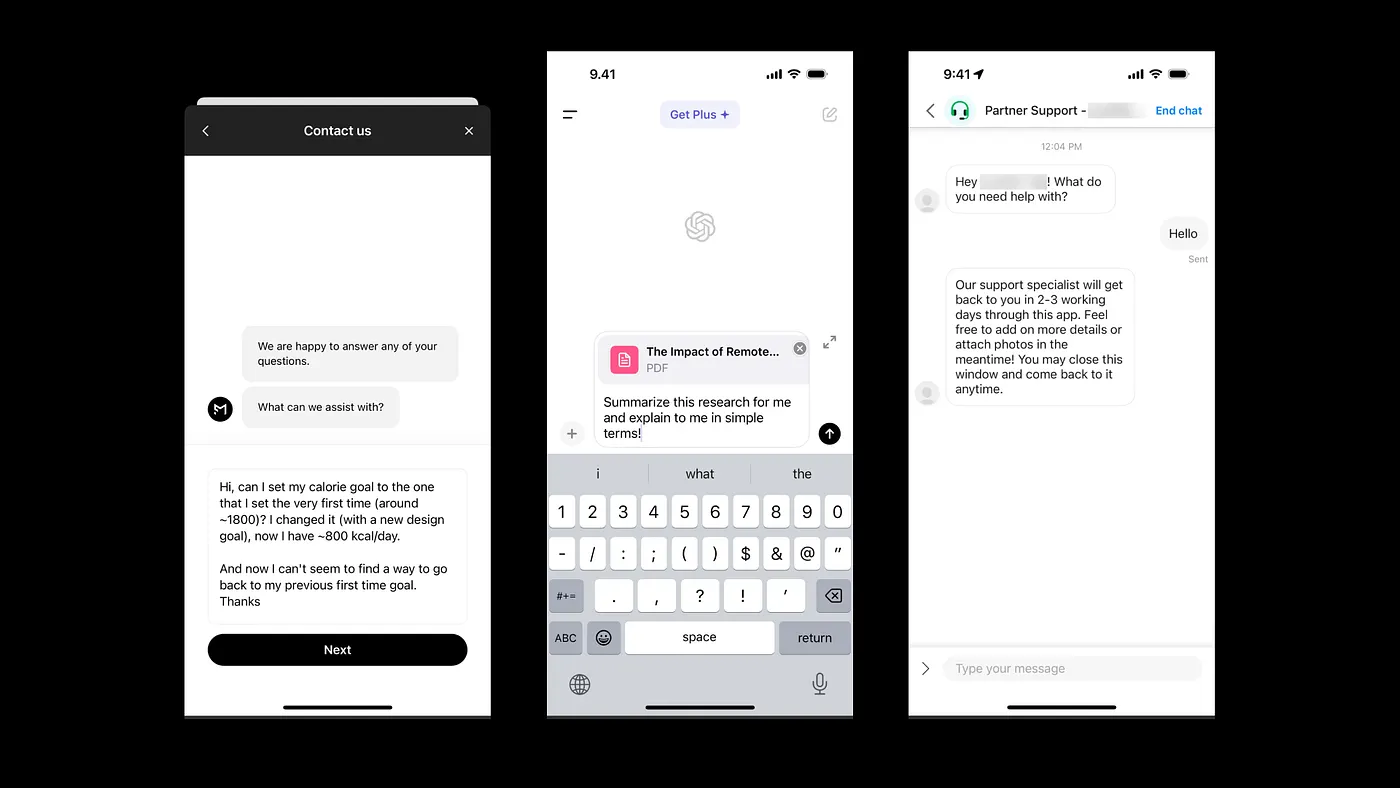
Writing a prompt that gets the best possible response is surprisingly tough. It requires a grasp of the language the bot was trained on, precision, and typing… so much typing.
Imagine I’m going to Paris and want help with an itinerary. I could prompt ChatGPT with a quick question…
Give me an itinerary for a visit to Paris in July, including sites and restaurants.
… and ChatGPT will gladly spit out an itinerary for this prompt - but neglects to clarify any part of what I’m asking.
- How long am I visiting for?
- What kinds of sites am I interested in?
- What kind of food do I like?
- What area am I staying in?
So, the end result is a nice read, with the most obvious tourist attractions (the Eiffel Tower is a must-see, at least once) but not a lot of soul. That’s because it’s better suited as somewhat of a blunt object at the moment, doing just what you ask, one question at a time. You can work around this by giving way more context, but does a new user know that? If you’re including chat on your app, do they know what inputs are expected?
Do the work for me
Instead of leaning on the human to type their question, product designers should consider all the angles and frame every part through the lens of their needs, and move AI to the background.
- Can we create a quick tappable narrative flow that sets context?
- Can we generate an interface based on answers to the previous questions and surface the next best options to click on, closing down on the actual answer with real precision?
- Can we completely remove a decision path because AI can determine the answer from context clues?
There will be a place for chat interface, but think of it as a second line UI. When the framing we’ve built around the intelligence is not enough, like in the case of a power user, or a subject matter expert, we can still reveal the ability to interrogate the data. This is in some cases preferable to assuming we know what the experience should be, like in the case of a broad-ranging problem that requires some detective work.
Today we’re in a state of retroactive “nail seeking”, with our giant chat-based hammer. We should do this. Most of the problems we solved previously didn’t have this tool ready for us, but soon, we can start looking forward instead, with AI as just another means to an end. We will soon get back to looking at a problem through the lens of the human experience and asking ourselves what outcomes we want to achieve, and AI will be just one of the tools product designers use to get to that outcome.